Showing posts with label Jerk. Show all posts

Saturday, October 11, 2014

Ryabchenko on Rack


According to Ryabchenko, the rack is the foundation of GS, and there is no sense to teach complicated moves without getting the rack right first. There is simply no good girevik without good rack (as well as without correct breathing). There are two basic variants of rack position.


On the picture above is the diagram of the rack where the hands are parallel to each other and at the same time perpendicular to the body. Ryabchenko calls this rack classical. The photo that follows shows Andrey Popov, many times champion of Russia and the World, typical example of such rack position.


The next figure shows another variant: the hands are parallel to the body and at the same time are turned away from it, while the bells are sort of resting on the forearms. The photo shows Ilia Popov, also many times Junior champion of Russian Federation and the World.


First time Ryabchenko noticed this variant of rack used by Ivan Ament from Kazakhstan, and he was immediately impressed by the rationality of it. In this variant the bells travel shorter distance and therefore less energy is spent during each lift.

Obviously, there is unlimited number of intermediate positions between the two variants, the most typical shown on the next figure.


Sometimes because of the mistakes made by coaches or, more commonly, when the athletes at the beginning train without guidance, they learn incorrect habits, which are especially visible in rack position. The next picture demonstrates the extreme bad case of incorrect rack.


In such position the bells are constantly pulling out, thus wrecking the coordination of the muscles. The arms fatigue faster. There is also another danger. Because in such rack the bells are positioned further forward, the center of gravity is also shifted in the same direction. When the bells are lowered the athlete is forced to extend his back more, and this increases the risk of trauma, which increases even more as the athlete gets tired.

I tried the second variant of the rack and have to admit that it did not feel comfortable at all. It may be my anatomy or bad habits, I don’t know. Most importantly, I am paying attention to not turning my palms in and to keeping them at least parallel to each other, as in the classical variant. Feel free to experiment and let me know how it feels.

Thursday, October 9, 2014

Flexibility in Girevoy Sport


In his recent appearance on StrongFirst Sergey Rudnev listed the qualities necessary for irevoy sport in the order of importance. According to him the order is as follows:

  1. Endurance
  2. Flexibility
  3. Technique
  4. Strength
This post is based on the article by Russian GS authority Gomonov* which was adapted from the website of Girevoy Sport Federation of Rostov District, http://www.fgsrostov.aaanet.ru/

The authors of the article believe that phase analysis of jerk is one of the most useful ways to achieve biomechanical control. In the article they discuss the role of flexibility and muscular strength topography in the structure of jerk.

On the basis of video analysis of athletes at one of the international GS tournaments in 1998 the athletes were divided into two classes: those with predominantly upper or lower muscular distribution. It is interesting that after episodic layoffs athletes with the upper muscular type preserved the ability to show good results in pushups and pull-ups and at the same time their results in exercises that reflect the strength of lower limbs sharply decreased. Vice versa, athletes with predominantly lower muscular distribution kept the results in jumps and squats but lost it in pushups and pull-ups.

Six phases of jerk were isolated. They are shown on the diagram below.


Phase 1. Flexibility is of particular importance in starting position. This phase – phase 1 – is sort of “fuelling station” where the body gets rid of the fatigue accumulated during working phases. Lack of flexibility in the hips and the spine does not allow deviating the trunk backwards without bending the knees. Therefore, instead of accumulating the strength before the next attack at the bells the athlete with limited flexibility has to perform static work with the knees bent. It is impossible to prevent the bells falling forward-down without deviating the trunk backwards, unless one uses additional effort of the arms, which, in turn, is also inefficient.

Phase 2: first dip, or half-squat. The athlete bends the legs in the knee joints to about 120 degrees. At the same time bodyweight is distributed evenly on the soles of the feet. Athletes with the lower muscular distribution bend the knees a little less because they have enough strength to accelerate the bells during shorter traveling distance. Those with low flexibility of the ankles lose contact of the heels with the floor and the muscles of the calves get involved prematurely.

Phase 3: jerking. It is performed by sharp straightening of the knees immediately after the dip. Contact of the arms with the trunk and elbows with the pelvis during this phase is maximal. Straightening of the knees ends up with the plantar flexion of the ankles – getting onto the balls of the feet. Arms are switched on only at the last moment, allowing to slow down vertical movement of the body and start the second dip. And again athletes with low flexibility are at disadvantage: the only difference between the final position of this phase and starting position is flexion of the feet. As you remember, low flexibility in SP does not allow complete straightening of the knees. These athletes have two possibilities: switch on the arms prematurely (in order to prevent the bells falling) or start the second dip before straightening the knees completely.

Phase 4: second dip. The goal of this phase is to catch the bells with the straight arms. The athlete bends the knees and the body moves downwards faster than the acceleration of the free falling object – because of the active straightening of the arms. Unlike during the first dip, during the second dip the pelvis moves not forward-down, but backwards-down.
Flexibility of the spine and the shoulders again determine the efficiency of this phase. Athletes with good flexibility reach optimal depth of the second dip by bending the knees less, to about 100 – 120 degrees in the knee joints. This allows distributing the load more evenly: moving part of it from the extensors of the hips and calves to the extensors of the trunk. Even by bending the trunk forward flexible athletes are able to get the bells overhead.
Gireviks with low shoulder flexibility, in order to keep the arms vertical have to deviate the trunk even a little backwards, and optimal depth of the second dip is achieved by sharper angle in the knee joints, 100 – 110 degrees.

Phase 5: fixation. When analyzing the rhythm of the jerk – relative duration of the phases – the authors noticed that the athletes with predominantly upper muscular distribution tend to pause in this phase. It is easily explainable. During this phase the muscles of the lower limbs are maximally relaxed, and muscles of the arms and the shoulder girdle allow reducing the fatigue of the quadriceps muscles by letting them stay relaxed longer (0.8 to 2.6 seconds). This sequence of events will be violated if the athlete with the upper type of distribution has low shoulder flexibility. This athlete will waste a lot of energy during fixation phase, fighting the tension of tight muscles-antagonists. In addition his chest is in less optimal condition for breathing, as it is limited by excessively stretched muscles.
There are no comments on phase 6 in the article which, I suppose, has the same issues with the flexibility as the starting position.

At the end of the article the authors propose complex of exercises aimed at improving flexibility of shoulders and elbows which, authors believe, will improve the phases of both dips and fixation. The picture below needs no explanations.


Maximal range of movement in joints is limited by stretching reflex, which serves protective purpose. If the maximal amplitude is held in static position this reflex fades and disappears in 25 – 30 seconds.

As with any stretching, its general principles are applicable to the proposed complex. As you probably know, there are three ways to stretch: static, ballistic and isometric. They are well described in many books and articles on stretching and can also be found on the Net. My favorite book on stretching is one by Thomas Kurz, Stretching Scientifically. Pavel’s stretching books are also good.

As if the headache of pushing through hundreds of jerks wasn't enough here is something else to do. There is no doubt though that improving flexibility will lead to the improvement in the technique and, consequently, competition numbers.

Prevention of Trauma in Girevoy Sport


Prevention of trauma is a key issue in sport in general and for older trainees in particular. Classic GS lifts are not too complicated, but if enough intensity and volume are added on top of imperfect technique injury may follow quickly. Loads in GS are significant. An athlete weighing 60-65 kg competing in jerk with 32 kg bells lifts his bodyweight for 10 minutes, and the total weight lifted in the competition set is counted in tons! How is it possible to take such beating without being injured? Answering this question would help to prevent many accidents in GS, especially among beginners.

The text that follows is adapted from the article by VF Tikhonov, the PhD from the Department of Physical Education and Sport of the State University of Chuvashia, posted on thehttp://www.fgsrostov.aaanet.ru/ , Girevoy Sport site of Rostov, the city in Russia*. The authors were studying more than three hundred gireviks of different levels from 2002 and analyzed video records of various national and international championships. As the result they found some criteria of technical efficiency and economy of movement of GS lifts. In this particular article special emphasis is made on starting, or rack position.

Starting position (SP) determines the effectiveness of the consequent phases of the jerk. It is, as said by another Russian scientist A Ukhtomsky, the state of “operational rest”, and though there is no visible movement in that position, it signifies readiness to action.

If you look at the pelvis from the side you can picture it as an upside down triangle where the top is the hip joint. The body is naturally balanced on top of the pelvis, so that the lines of the projected forces of gravity from the anterior and posterior parts of the body end up in front and behind the feet respectively.

Observing the GS athletes, Tikhonov and his colleagues discovered two variants of starting position, one characteristic for beginners and another adopted by advanced gireviks.The diagram above depicts ineffective SP. You can see that the line of projected force of gravity drawn from kettlebells down extends through the hip joint and further behind the knee, “forcing” the knee joint to flex, or bend. At the same time the weight of the athlete’s trunk and the head exerts extending force on the hip joint – bending backwards - and further flexing momentum in the knee joint. In order to keep the balance the athlete is forced to constantly strain flexor muscles of the back and quads. Novices instinctively bend the back, as well as bend and bring down the head. It allows bringing together projected lines of gravity of kettlebells and the trunk thus reducing the action of momentum of these forces. Inability to relax the deltoids and traps results in the inability to rest the elbows on the iliac bones of the pelvis. As the result inexperienced gireviks bend the knees and the back which, in turn, leads to excessive strain in those areas.
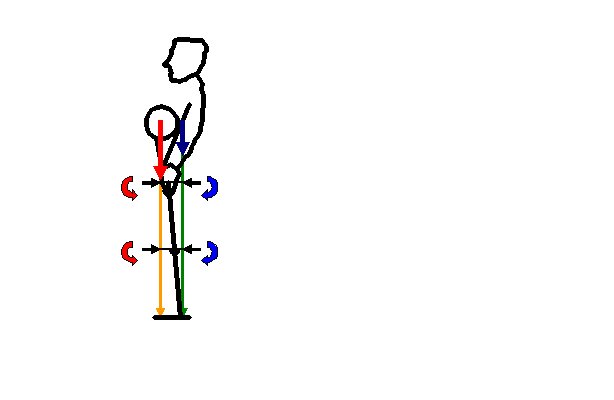


How is efficient SP different? It is shown on the figure above. Ideally, the pelvis is balanced on the hip joint. The line of projected line of gravity from the bells extends in front of the hip joint and creates flexing forces in the hip joints – bending the trunk forward. At the same time the line of gravity from the head and the trunk extends behind the hip joint. This way the weight of the bells and the weight of the upper body are balanced on the pelvis. In other words the advanced athletes bend the trunk and deviate it backwards not because of the force of the kettlebells, but in order to balance the opposing forces over the hip joint. Similar balance is achieved in knee joints as well thus reducing strain of quadriceps muscles, and in ideal case when these forces are fully opposing each other the quads relax completely.

Placing the handles of kettlebells on the heels of the hands, putting the elbows onto the iliac bones while knees are straightened and muscles of the arms are maximally relaxed reduce the excessive action of forces in these joints and improve the economy of movement. From this description it is obvious that flexibility of the hip joints is very important for achieving adequate starting position. According to Tikhonov, as a rule, athletes who don’t pay enough attention to the flexibility and mobility in the joints do not reach high levels in girevoy sport. Most of them remain at the level of CMS.

The authors come to the following conclusions.

  1. The main source of trauma in GS is the attempt to get high numbers using strength. This leads to the excessive strain in the knee joints and lumbar spine.
  2. Prevention of spinal strain can be achieved by proper compensation of the various forces exerted on the spine or.
  3. The solution lies in the improvement of the technique.

*The Sources of Trauma in Exercises of Girevoy Sport. (Источники травматизма в гиревом спорте). Tikhonov VF, PhD. State University of Chuvashia. Downloaded from the site of Federation of Girevoy Sport of Rostov District, http://www.fgsrostov.aaanet.ru/.

Mistakes in Jerk


As I wrote in July 2008, my then eleven year old daughter started doing swimming. As the parent it was inevitable for me to sit through a few sessions and watched her training. It was interesting to notice that the coach didn’t concentrate much on the technique of swimming during the first couple of months. If it more or less looked like breaststroke – it was ok, and kids did lots of laps. After a while the coach started correcting nuances in the technique. It made sense to me then and still does. I still believe that it is a valid way to learn GS lifts: start doing them, get to some level of strength endurance and then start finessing the technique.


This post is the excerpt from Alexander Gorbov's book "Girevoy Sport" and discusses common mistakes in jerk.
Mistake 1. In starting position and during pushing the bells up the arms are straining excessively and the fingers tightly squeeze the handles. As the result the muscles of the arms get fatigued quickly, never mind how strong they are.

Causes:
  • Incorrect position of the bells on the chest
  • Upper arms and elbows are not connected to the body
Correction.
  • Pay more attention to the starting position: find the most comfortable position of the bells on the chest, elbows must be sitting on the body.
  • Make sure the grip is correct and the handle is sitting on the heel of the hand. Fingers can be closed but not tensed.

Mistake 2. At the beginning of the pushing the bells fall off the chest. As the result the arms get involved at this stage and get fatigued.

Causes
  • The upper arms are not properly connected to the body and the bells are not connected to the forearms.
  • The chest is positioned too low at the beginning of the jerk.
Correction.
  • For better friction between the arms and the body Russian gireviks train in a wet t-shirt. I never tried it, and the posts on GS forums vary in opinion.
  • Timed holds of bells up to 10 seconds in starting position with the pelvis moved forward more than dictated by the technique.
  • Half-jerks for high reps

Mistake 3. The legs are not fully straightened at the end of the lift. As the result the bells get pushed up to insufficient height and deeper dip is necessary, leading to the fatigue of the legs. It may also tip the athlete off balance.

Causes.
  • Weak leg extensors
  • The first dip is too low
Correction is achieved by strengthening the legs with the following exercises.
  • Squats, either with a barbell or kettlebells
  • Half-jerk with slight dip and getting to the tiptoes
  • JUmp squats with a barbell or kettlebells, done “softly”

Mistake 4. Insufficient, shallow second dip. As the result the straightening of the arms and holding the bells in top position is difficult.

Causes.
  • Mistakes during learning the technique
  • Insufficient flexibility in elbow and shoulder joints
Correction.
  • Static overhead holds in semi-squatting positions of varying depth
  • Same as above but moving forward
  • Perform exercises to improve shoulder and elbow flexibility

Mistake 5. In the top position the bells are “pulling forward”. This makes maintaining the position difficult.

Causes.
  • In overhead position girevik shifts the center of gravity forward
  • Insufficient flexibility of the shoulders and arms

Correction.
  • After the first dip the push is done from the heels. Getting on the tiptoes is done only after the knees are fully straightened. The following exercises are recommended.
  • Semi-squats with the bells in the starting position. Pay attention to keeping the center of gravity on the heels.
  • Half-jerk from heels, without getting on the tiptoes.
  • Semi-squats with the bells in overhead position

Mistake 6. The first dip too low. As the consequence big leg extensors are working excessively and get fatigued. The jerk becomes “soft”.

Causes.
  • Inability to utilize the springing properties of the chest, spine and abdominal muscles in order to reduce the load on the legs
  • First dip too slow
  • Weak leg muscles
Correction
  • Static holds in starting position with the legs slightly bent, 10 seconds
  • Half-jerk doing small first dip, paying attention to the “spring” action of the chest
  • Jump squats with a barbell
  • Pushing the bells up using the chest, without bending the knee joints
Mistake 7. In top position the arms are falling to the sides.
The main problem here is the flexibility of the shoulders and elbows. The following exercises may be helpful.
  • Semi-squats with the bells overhead and touching
  • Walking with the bells overhead and toughing

Mistake 8. When lowering the bells to the chest the legs bend excessively when absorbing the shock. This causes the fatigue of the legs.

Cause
  • Incorrect shock absorbing technique
Correction
  • Jerk light bells. When lowering, simultaneously get to the tiptoes and shrug the shoulders. As soon as the bells touch the chest. Lower the shoulders, move the pelvis slightly forward and get back onto the heels. Do not bend the knees.